Symbols Visual Art Sculpture Lierature Drama Architectual Developments Christianity
The art, or the expressions of the human experiences in the Philippines mirror a general public with assorted social impacts and conventions. The Malayan people groups had early contact with merchants who presented Chinese and Indian impacts. Islamic conventions were first acquainted with the Malays of the southern Philippine Islands in the fourteenth century. Almost current parts of Philippine social life advanced under the unfamiliar standard of Kingdom of spain and, afterwards, the United States. In the sixteenth century the Spanish forced an unfamiliar culture situated in Catholicism. While the marsh people groups were assimilated through strict transformation, the Muslims and some upland ancestral gatherings kept upwards social freedom. Among the individuals who were absorbed emerged an informed tip top who started to gear up a cutting edge Filipino artistic custom. During the primary portion of the twentieth century, American impact made the Philippines one of the most Westernized countries in Southeast Asia. The social developments of Europe and the United States significantly affected Filipino specialists, much later autonomy in 1946. While drawing on Western structures, in whatsoever case, crafted by Filipino painters, essayists, and performers are instilled with peculiarly Philippine topics. By communicating the social extravagance of the archipelago in the entirety of its decent diverseness, Filipino specialists have assisted with molding a feeling of national character. Numerous Malay social customs accept made due regardless of hundreds of years of unfamiliar standard. Muslims and upland ancestral gatherings keep up unmistakable conventions in music, dance, and sculpture. What's more than, numerous Filipino artist fuse indigenous lodge themes into current structures. The visual arts are fine art forms such every bit painting, cartoon, printmaking, sculpture, ceramics, photography, video, filmmaking, pattern, crafts, and architecture. Many artistic disciplines such as performing arts, conceptual art, textile arts besides involve aspects of visual arts likewise every bit arts of other types.
Visual arts in Pre-Spanish Colonial Period
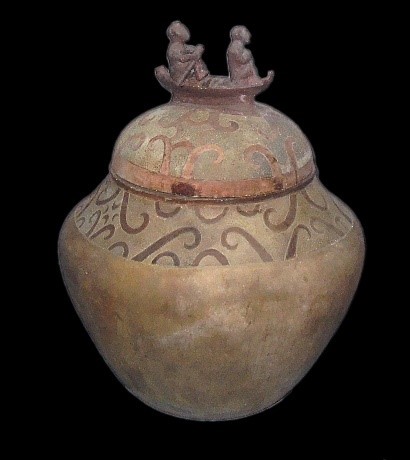
Manunggul Jar from Palawan (890–710 BC)
Early Filipino painting tin be constitute in cherry-red slip (clay mixed with water) designs embellished on the ritual pottery of the Philippines such as the acclaimed Manunggul Jar.
The Manunggul Jar is a secondary burial jar excavated from a Neolithic burial site in Manunggul cave of Tabon Caves at Lipuun Betoken at Palawan dating from 890–710 B.C
Painting are too manifested in the tattoo tradition of early Filipinos, whom the Portuguese explorer referred to equally Pintados or the 'Painted People' of the Visayas.
Early Filipino'south painting can exist manifested today amid the arts and architecture of the Maranao who are well known for the Nāga Dragons and the Sarimanok carved and painted in the beautiful Panolong of their Torogan or King'south House.
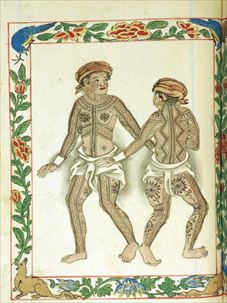
Visayan pintados
Visual arts in Spanish Colonial Period
Creative paintings were introduced to the Filipinos in the 16th century when the Spaniards arrived in the Philippines. Spaniards used paintings as religious propaganda to spread Catholicism throughout the Philippines. Paintings appeared mostly on church walls, featured religious figures appearing in Catholic teachings. Filipinos began creating paintings in the European tradition during the 17th- century Spanish period. Well-nigh of the paintings and sculptures between the 19th, and 20th century produced a mixture of religious, political, and landscape art works, with qualities of sweetness, dark, and light.
Visual arts in Post-Castilian Colonial Period (Mod)
Early modernist painters such as Damián Domingo was associated with religious and secular paintings. The art of Juan Luna and Félix Hidalgo showed a trend for political argument. Artist such equally Fernando Amorsolo used post- modernism to produce paintings that illustrated Philippine culture, nature, and harmony.
Sculpture
Sculpture is the co-operative of the visual arts that operates in three dimensions. It is one of the plastic arts. Durable sculptural processes originally used carving (the removal of material) and modelling (the addition of material, as dirt), in rock, metal, ceramics, woods and other materials but, since Modernism, there has been an near complete freedom of materials and procedure. A wide diverseness of materials may exist worked by removal such as carving, assembled by welding or modelling, or moulded or bandage.
Philippine Sculpture is the virtually familiar fine art forms amongst Filipinos. From the transitional carving of anitos to the santos to Christ and down to the saints, Filipinos observe it rather not hard as they are already familiar with.
Indigenous woodcarving is one of the almost notable traditional arts in the Philippines, with some crafts in diverse ethnic groups appointment back prior to Hispanic arrival with perhaps the oldest surviving today are fragments of a wooden boat dating to 320 Advertizement.[50] Many societies utilize a variety of woods into making wood crafts such as sacred bulul figures. These divine wooden statues, known in various groups through different generic names, grow throughout the Philippines from the northern Luzon to southern Mindanao. The art of okir on wood is another fine craft attributed to various indigenous groups in Mindanao and the Sulu archipelago. Forest crafts of specific objects, such as sword hilts, musical instruments, and other objects are as well notable, where depictions of aboriginal mythical beings are commonly carved. There are other indigenous woods crafts and techniques in the Philippines, some of which have been utilized in Hispanic woodcarvings afterwards colonization, such as the woodcarving styles of Paete.
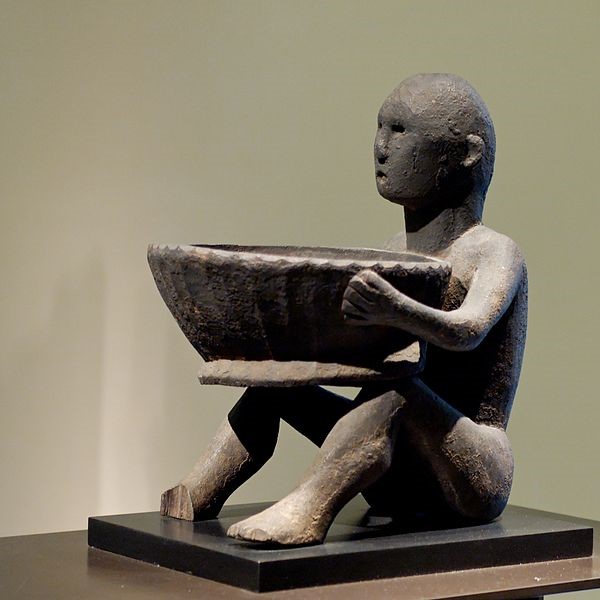
Bulul god with pamahan cup (15th century)
Religious Hispanic woodcarvings abounded in the Philippines with the introduction of Christianity. The techniques utilized infuse both indigenous and Hispanic styles, creating a fusion of Hispanic-Asian wood art. Paete, Laguna is among the well-nigh famous woodcarving places in the country, peculiarly on religious Hispanic woodcarving. Various epicenters of woodcarving in the Hispanic tradition are also present in many municipalities, where majority of the crafts are attributed to the life of Christ and the Virgin Mary, where Marian traditions prevail.

Bas relief at Panay Church (1770's)
Rock carving is a priced art form in the Philippines, even prior to the arrival of Western colonizers, every bit seen in the stone likha and larauan or tao-tao crafts of the natives. These items commonly represents either an ancestor or a deity who aids the spirit of a loved one to go into the afterlife properly. Ancient carved burial urns have been found in many areas, notably in the Cotabato region. The Limestone tombs of Kamhantik are elaborate tombs in Quezon province, believed to initially possess rock covers signifying that they were sarcophagi. These tombs are believed to have been originally roofed, as evidenced by holes marked onto them, where beams take been placed. Stone grave marks are as well notable, with the people of Tawi-Tawi, and other groups using the carved marks with okir motif to help the expressionless. In many areas, sides of mountains are carved to grade burial caves, peculiarly in the highlands of northern Luzon. The Kabayan Mummy Burial Caves is a prime number example. Marble carvings are likewise famous, particularly in its epicenter in Romblon. Majority of the marble crafts are currently meant for export, mostly Buddhist statues and related works.With the arrival of Christianity, Christian rock carvings became widespread. Most of which were either parts of a church such as facades or interior statues, or statues and other crafts intended for personal altars. A notable stone carving on a church is the facade of Miagao Church.
Ivory carving is an art practiced in the Philippines for more than a yard years, with the oldest known ivory artifact known is the Butuan Ivory Seal, dated 9th–12th century. The religious carvings of ivory, or garing as locally known, became widespread after the directly importation of ivory into the Philippines from mainland Asia, where carvings focused on Christian icons, such equally Madonna with Kid, the Christ Child, and the Sorrowful Mother. Many of the ivory carvings from the Philippines have gold and silver designs. The ivory trade in the Philippines boomed because of the need for ivory carvings, and connected up to the 21st century. In recent years, the Philippine regime has been cracking downwardly on the illegal ivory trade. In 2013, the Philippines became the first country in the world to destroy its ivory stock, to show solidarity amongst agreeing nations against the ivory trade which has decimated the world's elephant and rhino populations. Horns of expressionless carabaos have been used as a substitute to ivory in the Philippines for centuries.
Architecture
Architecture is an artistic expression that reflects how nosotros present ourselves over the world's scene, and, as other expressive mediums, it changes with styles, advancements and social transformations.
The compages of the Philippines reflects the historical and cultural traditions in the country. Near prominent historic structures in the archipelago are influenced by Austronesian, Chinese, Spanish, and American architectures.
For 2,000 years the mountainous province of Ifugao have been advisedly cultivated with terraced fields. The structures' original builders used stone and mud walls to carefully carve and construct terraces that could hold flooded pond fields for the tillage of rice. They also established a organization to water these plots past harvesting h2o from mountaintop forests. These technology feats were washed past hand as was the farming itself.
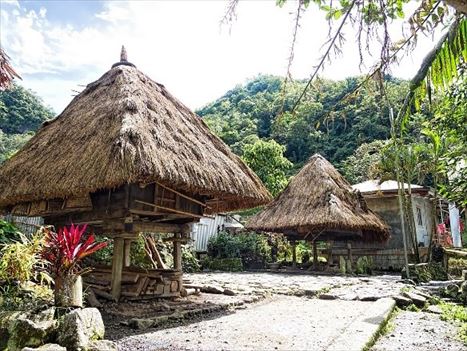
Maintenance of the rice terraces reflects a primarily cooperative approach of the whole community. Invention of various tools allowed for the fabrication of tent-similar shelters and tree houses. Early on Classical houses were characterized by rectangular structures elevated on stilt foundations and covered by voluminous thatched roofs ornamented with gable- finials and its structure could exist lifted every bit a whole and carried to a new site.
The Bahay Kubo is the Filipino word for Nipa huts, they were the native houses of the indigenous people of the Philippines before the Spaniards arrived. They are still used today, specially in rural areas. Different architectural designs are present amongst the different ethnolinguistic groups in the country.
With the arrival of Indianized and Muslim scholars from nearby Republic of indonesia, the native Filipinos were introduced to the concept of the Kota or fort. The Muslim Filipinos of the south built strong fortresses chosen kota or moong to protect their communities. These kotas were usually made of stone and bamboo or other light materials and surrounded by trench networks. Many of these forts were also destroyed by American expeditions, equally a consequence, very very few kotas still stand to this day.
The existing torogans were congenital by the community and the slaves for the King in 1800s. The windows of torogan are slits and richly framed in forest panels with okir designs located in forepart of the house. The singled-out high gable roof of the torogan, thin at the apex and gracefully flaring out to the eaves, sits on a structure enclosed by slabs of timber and lifted more than ii meters higher up the footing past a huge torso of a tree that was assail a rock. The house was congenital to sway during earthquakes. 20-five post of huge tree trunks were not buried but are freestanding.
With the inflow of Islam in Mindanao, Mosques, the masjid was extensively built, like the Sheik Karimal Makdum Mosque in Simunul, Tawi-Tawi, which was built in 1380. During the institution of the Sultanate of Sulu, a wooden palace was built for the Sultans which had the name Astana Darul Jambangan which has been destroyed past a typhoon in 1912. A replica of the regal palace was rebuilt as an allure in Mt. Bayug Eco-Cultural Park in the town of Talipao, Sulu.
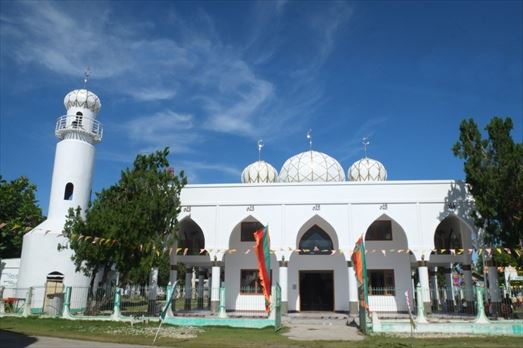
Sheik Karimol Makhdum Mosque
The inflow of the Spaniards in 1571 brought in European colonial architecture to the Philippines. Since the Spaniards brought Christianity to the islands, they created the need to establish religious structures to support the growing number of religious organizations. Some of the best-preserved colonial churches in the country are establish in the Ilocos Region, as well as those in the provinces of Laguna, Batangas, Cebu and Bohol.
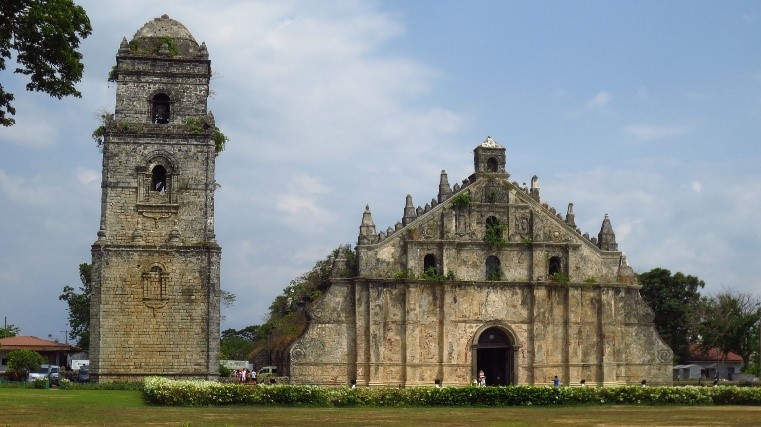
St. Agustin church, Paoay, Ilocos Norte
The Bahay na bato, the colonial Filipino house, followed the nipa hut's arrangements such as open ventilation and elevated apartments. The bahay na bato was constructed out of brick and stone rather than the traditional bamboo materials. Information technology is a mixture of native Filipino, Spanish and Chinese influences. During the 19th century, wealthy Filipinos built some fine houses, usually with solid stone foundations or brick lower walls, and overhanging, wooden upper story with balustrades and capiz shell sliding windows, and a tiled roof.
The historic metropolis was habitation to centuries-old churches, schools, convents, authorities buildings and residences, the best collection of Spanish colonial architecture before much of it was destroyed by the bombs of World War II. Of all the buildings within the 67- acre city, just i edifice, the San Agustin Church, survived the war.
With the arrival of the Americans in 1898 came a new breed of architectural structures in the Philippines. Foremost of the American contributions to the country was the establishment of civil regime. This led to the erection of regime buildings from the city all the way to the municipal level.
The modernistic era dawned on Philippine architecture using the uncomplicated straight lines of the International Modern Fashion as a principal manner of expression. By the 1970s, a new form of Philippine compages emerged with the filipinization of compages. By the 1980s the country's architectural idiom was swept by the tide of Mail service Modernism, a hearkening back of some sort to classical architecture. Today, compages in the Philippines go along to exist vibrant and with the land opening up to the globe, more first rate compages is pouring in.
The Cultural Centre of the Philippines Circuitous is habitation to the National Theater (Tanghalang Pambansa). The theater is the centerpiece of the 77 hectare (190 acres) arts and culture circuitous located along Roxas Boulevard in Manila. Designed by Leandro V. Locsin, the construction of the National Theater began in 1966 and was completed in 1969. The theater is a primary example of the architect'south signature style known as the floating volume, a trait can be seen in structures ethnic to the Philippines such as the nipa hut. It houses three performing arts venues, one theater for film screenings, galleries, a museum and the eye's library and archives.
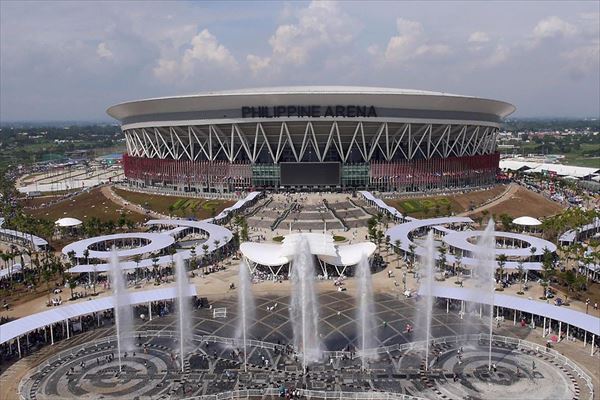
Philippine Loonshit
The Philippine Arena is a multi- purpose indoor loonshit existence synthetic at Ciudad de Victoria, a 75-hectare tourism enterprise zone in Bocaue and Santa Maria, Bulacan, Philippines. With a capacity of upwards to 55,000, it is the globe'due south largest indoor arena once completed.
The visual arts in the Philippines envelop a scope of structures created by Filipinos in the Ethnic, Spanish, American, and gimmicky customs. In ethnic communities, pottery, weaving, carving, and metalcraft are made for formalism purposes or for ordinary employ. Spanish colonization presented painting and model whose topic was mostly strict, albeit mainstream subjects and structures developed in the nineteenth century under the back up of the new mestizo first class. The American time frame saw the contention among conservatism and innovation, with the last making progress at long last in painting and figure. After World War II specialists investigated an assortment of Western and Eastern styles, media, and methods of reasoning—some conciously returning to ethnic roots—to communicate equally people and as Filipinos.
I think Historical changes are presumably one of the most significant movements in art way use. They modify numerous parts of styles including the social and material changes. I too think in whatsoever periods of time, art will always be there for artists to express themselves in whatsoever form of fine art that they choose, becasue for an artist, art is an expression made noticeable past a structure. The articulation contained in the construction is an endeavor to interpret the anonymous and the obscure. Natural for our reality as people is our journey to make significance, and craftsmanship permits that procedure to happen. Making importance includes understanding our environmental factors and denoting our encounters.
Sources:
https://en.wikipedia.org/wiki/Paoay_Church
https://www.burohappold.com/projects/philippine-loonshit/
Source: https://the-buchiblo.com/en/2020/08/19/visual-arts-in-philippines/
0 Response to "Symbols Visual Art Sculpture Lierature Drama Architectual Developments Christianity"
Post a Comment