Art From the Peoples Republic of China March 16 30 1980 Poster
I n the first calendar week of January 2016, a vast golden statue of Mao, rising upward out of frozen brownish fields, was unveiled in the centre of the Henan countryside in central Communist china. More than 36 metres loftier, it cost £312,000 and was paid for by local people and businessmen. Tourists gathered to have selfies, but a few days later, the monument was demolished, apparently for violating planning regulations. Several locals wept every bit it came downward, amid them probably descendants of the multitudes – one analyst puts the effigy at 7.8 million – who died in Henan during the famine in the 1960s caused by Mao's policies.
The gilded colossus of Henan evokes the strange, looming presence of Mao in contemporary China. The People's Democracy (PRC) today is still held together by the legacies of Maoism. Although the Chinese Communist party (CCP) has long abased the utopian turmoil of the Cultural Revolution in favour of an authoritarian capitalism that prizes prosperity and stability, Mao has left a heavy mark on politics and society. His portrait – six by 4 and a one-half metres – hangs in Tiananmen Square, the heartland of Chinese political power, and in the center of the square, his waxen, embalmed body lies in state. "Mao's invisible hand" (as one contempo book puts it) remains omnipresent in China'southward polity: in the deep politicisation of its judiciary; the supremacy of the one-political party country; the intolerance of dissident voices. And in 2012, the CCP nether Eleven Jinping began – for the offset time since Mao's death in 1976 – to publicly renormalise aspects of Maoist political culture: the personality cult; catchphrases such as the "mass line" (supposedly encouraging criticism of officials from the grassroots) and "rectification" (disciplining of wayward party members). At the stop of Feb 2018, Xi and his Central Committee abolished the 1982 constitutional restriction that limited the president to only 2 consecutive terms; like Mao, he could be ruler for life.
The western commentariat has been wrong-footed by Mao'southward resurgence. Many perchance causeless that, equally China turned commercial and capitalist since the decease of Mao, the country would become "more like us"; that Mao and Chinese communism were history. The opposite has happened. Maoism is the key to understanding one of the nearly surprisingly enduring organisations of the 20th and (then far) 21st centuries – the CCP. If the party is still in accuse in 2024, the Chinese communist revolution will have exceeded the 74-year lifespan of its Soviet older blood brother. And if the Chinese communist state survives much across this point, historians may come to come across October 1949, rather than October 1917, as the game-changing revolution of the last century.

At that place is also a pressing demand to evaluate the power and attraction of Maoism across China; it has had a long afterlife in revolutions and insurrections (that take transformed states and left millions dead) in Kingdom of cambodia, Zimbabwe, Peru, Bharat and Nepal, based on Mao's theories of class struggle and guerrilla warfare. The story of Maoism's travels takes in the tea plantations of north India, the sierras of the Andes, Paris's 5th arrondissement, the fields of Tanzania, rice paddies in Kingdom of cambodia and terraces in Brixton. A potent mix of party-edifice discipline, anti-colonial rebellion and "continuous revolution" grafted on to the secular faith of Soviet Marxism, Maoism not only unlocks the contemporary history of China, but is likewise a pivotal influence on global insubordination and intolerance across the last 80 years.
But beyond China, and especially in the westward, the spread and confusing importance of Mao and his ideas are only dimly sensed, if at all. They have been effaced by the end of the cold state of war, the apparent global victory of neoliberal capitalism, and the resurgence of religious extremism. Especially since the communist collapse in Europe and the USSR, western governments have imagined that Maoism was a historical and political phenomenon long past its sell-by date; that there was no need to appoint seriously with it, because information technology had been left in the dust by the supposed death of ideology in 1989. A fresh await at the cold war and global politics today tells a very different story: of Maoism as 1 of the nearly significant and complicated forces of contemporary history.

Maoism is a set of contradictory ideas that has distinguished itself from Soviet guises of Marxism in several important ways. Giving heart phase to a non‑western, anti-colonial agenda, Mao alleged to radicals in developing countries that Russian-style communism should be adapted to local, national weather. Diverging from Stalin, he told revolutionaries to take their struggle out of the cities and to fight guerrilla wars deep in the countryside. He preached the doctrine of voluntarism: that by sheer audacity of belief the Chinese – and any other people with the necessary forcefulness of volition – could transform their country. Revolutionary zeal, not weaponry, was the decisive factor. Although, like Lenin and Stalin, Mao was determined to build a militarised one-party state worshipful of its supreme leader, he as well (especially in his last decade) championed an anarchic insubordination, telling the Chinese people that "it is right to insubordinate". During the Cultural Revolution (1966-76), he deployed his own cult to mobilise millions of Chinese people – especially star-struck, indoctrinated youth – to smash political party rivals whom he deemed counterrevolutionary.
Born in an era in which Red china was held in contempt past the international organization, Mao, through the 1940s, assembled a applied and theoretical toolkit for turning a fractious, declining empire into a defiant global power. He created a language that intellectuals and peasants, men and women could sympathise; a disciplined army; a system of propaganda and thought control that has been described equally "one of the virtually ambitious attempts at human manipulation in history". He gathered around him a company of ruthless, unusually talented comrades, and his ideas elicited extraordinary levels of fervour. Millions entered into marriages of political convenience and abandoned their children to devote themselves to a utopian experiment. Many of these children in turn denounced, humiliated and – in extreme cases – killed their parents in the 1960s and 70s, in his name.
Maoism's global touch on began in the 1940s in Asia: in states on Prc's borders breaking with European and Japanese empires, and in the start conflicts of the cold war – Malaya, Korea, Vietnam. Here, Mao's anti-imperial chutzpah, veneration of asymmetric warfare and above all his obsession with closed party-building inspired and supported ambitious rebels. The Malayan Communist party – instigators of the insurrection that the rattled British empire called the "Malayan emergency" – was led by ethnic Chinese Malays who listened to the crackling tones of Radio Peking in the jungle and wore Mao'south image on brooches. Between the 1940s and 1970s, they made medical and study pilgrimages to mainland People's republic of china, where they were housed in Beijing's elevation-hush-hush International Liaison Department and enjoyed Sabbatum-night dances with the Politburo.

Mao saw himself as leader of the world revolution – even before the founding of the People's Republic, he had opened for business concern in Beijing a Comintern-way training academy for Asian revolutionaries. When Kim Il-sung'due south attempt to reunify Korea under his communist regime foundered in 1950, Mao propped upwards the North Koreans by sending 3 one thousand thousand Chinese personnel (of whom at least 360,000 were killed or injured) to Kim's rescue. After North and Republic of korea, and their Chinese and American backers, had fought each other to a standstill in 1953, Kim rebuilt his country substantially with Prc's help and forth Maoist lines: worship of the "beloved leader", breakneck mobilisation of the Due north Korean population into political evolution campaigns, and regular waves of purges. Maoist history and ideas – the retention of Chinese sacrifice in the Korean War and the two states' shared ideological origins – take helped preserve the China's support for Democratic people's republic of korea; without that assistance, we would not be confronted past the electric current threat of potential nuclear destabilisation and by harrowing human rights abuses in North korea.
The Vietnamese communists – adversaries of the The states in the hottest conflict of the cold war – were, in the words of ane insider, "disciples of Mao". Every bit Ho Chi Minh planned and fought his rebellions confronting French and so Us command, he relied heavily on material help and strategic blueprints from Mao. The Maoist hymn, "The Due east Is Crimson", became a Vietnamese anthem; Mao Zedong Thought was sworn in every bit "the bones theory" of Vietnamese communism. Betwixt 1950 and 1975, Communist china donated some $20bn in aid to N Vietnam, trained thousands of its students and cadres in China, and supplied myriad useful items: roads, bullets and uniforms, soy sauce and lard, ping-pong balls and mouth organs. Without Maoist-Chinese intervention, the North Vietnamese communists would not have been able to fight the French and then the US to exhaustion between 1945 and 1973.
Just the Maoist intervention left heavy scars on Vietnam. Mao and his lieutenants fabricated material back up contingent on Ho Chi Minh importing China'southward trigger-happy model of land reform in the 1950s; a conservative gauge in 2002 judged that 80% of the political punishments meted out – including equally many every bit 30,000 executions of "bullying landowners" – were mistaken.
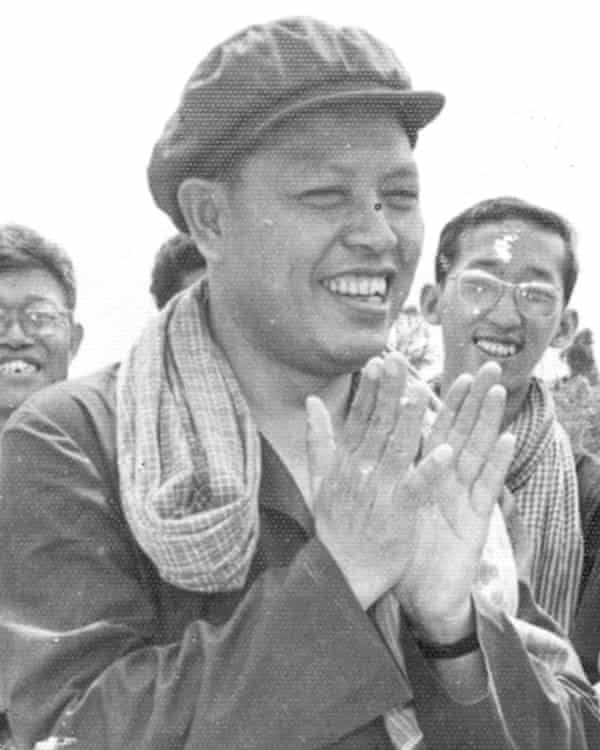
Kingdom of cambodia suffered worse. From the 1950s, Mao and his toughest, most charming lieutenants wove a careful network of influence around the land. The CCP sponsored Pol Pot's insurgency against the Cambodian state and were the Khmer Rouge'southward main backers later they took power in 1975. When Pol Pot visited his benefactor that summer, Mao – although physically bilious from a course of motor neurone disease – was buoyed by the encounter: "We approve of yous! Many of your experiences are better than ours." Although the Central khmer Rouge proved to be unruly allies, they translated into Cambodian primal ingredients of Mao's political model: radical collectivisation, a pathological suspicion of the educated, the paranoia and abiding purges of the Cultural Revolution. By early 1979, around 2 one thousand thousand – some twenty% of the population – had died unnatural deaths. The state's current leader Hun Sen, a former Central khmer Rouge commander with an appalling record of political violence, is 1 of the globe's longest-serving prime ministers.
While the Khmer Rouge committed genocide, western Europe and North America ran their own Maoist fevers. The noisy protest culture of the tardily 60s passionately identified with Mao's message to his youthful Red Guards that it was "correct to rebel". Mao badges were pinned on educatee lapels, Mao quotations were daubed on the walls of lecture halls. Maoist-anarchists scrambled to the top of a church building in West Berlin and bombarded passersby with hundreds of Piffling Red Books. A 1967 issue of Lui magazine (a French version of Playboy) included a special China supplement, titled The Little Pink Book, illustrated by Mao soundbites and snaps of young women dressed – if at all – in Mao jackets and playfully assuming imitation-militant Cultural Revolution poses. 1 young woman, naked except for a rifle, leapt out of a vast white cake, to the Maoist dictum "revolution is not a dinner party". At least 1 professional militant in the Bronx read the Trivial Red Volume to his marijuana constitute to aid information technology to grow.
Amongst widespread disgust at US intervention in Vietnam, western radicals' fellowship with Mao's China – tireless in its rhetorical attacks on America – followed the logic of "my enemy's enemy is my friend". Afterwards the quashing of the Hungarian uprising in 1956 and with the invasion of Czechoslovakia in 1968, the Soviet Union no longer represented a rebellious bulwark against commercialism. The People's Republic of Communist china – bigger than Vietnam, more than remote than Cuba, more than extreme than them both – looked the best culling. Sympathy with Mao's Mainland china merged with outrage over the mistreatment of American "internal colonies" – black, Latin and Asian American. Impressed by Mao'south denunciations of The states foreign policy and expressions of solidarity with black rights, the militant wing of the African American liberation movement channelled Mao's ideas to challenge the white American ruling institution. The Black Panthers sold Little Red Books to generate funds to purchase their offset guns.
Later on the European protest movement of the belatedly 60s petered out, Cultural Revolution-inspired radicalism bled into urban terrorism in West Frg – the Cherry-red Army Faction (AKA the Baader-Meinhof grouping) acquired 34 deaths in the 70s alone – and in Italy, where the Red Brigades committed some 14,000 acts of violence, resulting in 75 deaths, between 1970 and 2003. Both the RAF and the Cerise Brigades larded their declarations with Mao quotations: "imperialism and all reactionaries [are] paper tigers"; "whoever is non agape of being fatigued and quartered, can dare to pull the emperor from his equus caballus".
Following Mao's death in 1976, and the Communist china's own denunciation of the Cultural Revolution as "10 years of anarchy", western enthusiasm for Mao faded. But in the developing world – above all in Republic of india and Nepal – his ideas remained powerfully appealing. In that location, Mao's revolution represented a blueprint for political success obviously suited to poor, agrarian states that had suffered at the hands of colonialism. High-caste rebels seduced by Cathay's technicolour propaganda dream of an egalitarian utopia led Maoist insurgencies years, even decades later the chairman'due south decease. These leaders, paradoxically, have come from the educated classes of which Mao himself was so mistrustful. One – the privately educated brother of a Mumbai ice-foam entrepreneur – trained in London as a chartered accountant before declaring state of war on the Indian state.

Republic of india'due south Maoist insurrection began with the Naxalite rebellion of 1967, one of the major regional explosions of Mao's Cultural Revolution. While that earlier conflagration was for the about part extinguished in the early on 1970s by a harsh state response, splinters of the original motility fought on. The Indian government currently claims that 20 of the state'south 28 states are affected by the Maoist insurgency, which it has called "the biggest internal security challenge facing our state". This war owes its survival to Maoist groups' readiness to attack some of India's socioeconomic enormities, such as the hierarchical violence of the caste system and the racist exploitation suffered by the poorest tribal peoples. In the new millennium, the Maoists have gained further traction by linking their cause to environmental protests. Later on 2003, the Indian land – ambitious to increase revenues – began granting lucrative mining contracts to multinational corporations, especially in mineral-rich Chhattisgarh and Jharkhand. Maoist insurgents organised locals into resisting state and corporate efforts to empty land ready for industrial development.
Maoist civil state of war in Nepal started at 10pm on 12 February 1996, when 36 members of the Communist party of Nepal (Maoist) rushed a police station in Rolpa, in the north-west. (Apart from a motley assortment of abode-made firearms, they possessed only one rusty burglarize, dating from the tardily 1980s.) A decade afterward, the Nepali Maoists had fought their way to a position of decisive political influence. Pushing back against the firepower of the Nepali police and ground forces, their People'southward Liberation Ground forces was 10,000 strong and had wrested 80% of Nepal's territory from state control. Their armed rebellion was the principal reason for the collapse of the monarchy and the establishment of a federal republic in Nepal after 2006. Betwixt 2006 and 2016, 2 leaders of the Maoists (both, similar their Indian counterparts, high-caste) served betwixt them 3 terms equally prime minister of Nepal and many other senior party figures held authorities positions. Although they did not realise their original appetite – state capture resulting in unchallenged control of the state, as achieved by the Chinese Communist party – Nepal is now the simply land in the world where you tin can see self-avowed Maoists in power.
Both these conflicts took place through and beyond the supposed end of the cold war. The Maoist insurgencies in Nepal and India blazed years after Francis Fukuyama declared that humans had reached "the end of history" with capitalism's definitive victory over communism. In one case you write Maoism back into the global history of the 20th century, then, yous start to get a very different narrative from the standard 1 in which communism loses the cold state of war in 1989. Nowhere is this storyline clearer than in China. More than a quarter of a century since communism disintegrated in Europe and then in the USSR, China's Communist party continues – seemingly – to flourish. Nether its management, China has go a earth economic and political strength. The CCP – its practice and legitimacy still dominated by Mao – has with quite extraordinary success recast itself every bit a champion of the marketplace economic system, while remaining a secretive, Marxist-Leninist organisation. Although Mao'south successor, Deng Xiaoping, mothballed the keynote policies of the Cultural Revolution – communes and mass-spectacle purges – Mao is even so key to the Communist china's political and institutional framework.
Just Mao enjoys an uncomfortable legacy in contemporary China. The leaders of the CCP try to exploit Mao'south fuzzy male parent-of-the-nation symbolism, in club to shore up Communist party rule. Notwithstanding there are major aspects of the Maoist heritage that strongman Xi Jinping is determined to suppress: above all the bottom-up mobilisations of the Cultural Revolution that virtually destroyed the party-country in the late 1960s. Xi'due south Cathay is in whatever instance different (nearly beyond recognition) from Mao's: tied into global finance, its political equilibrium and legitimacy bound to economic performance rather than ideological purity, its media as well diversified for a single official message to convince its increasingly well-travelled, aggressive (and revenue enhancement-paying) citizens. Xi's selective revival of the Maoist political repertoire sits awkwardly inside a China that is so transformed from the Mao era.
And large, unstable parts of the Mao cult continue to flourish beyond political party control. Afterward the CCP dismantled urban welfare and job security in the tardily 1990s, laid-off workers marched in protest, brandishing portraits of Mao, whom they acclaimed as the patron saint of workers' rights. Neo-Maoists in Red china angry at the inequalities generated past the market and globalisation quote Mao's Cultural Revolution incitement to rebel against the land. The CCP has washed its all-time to co-opt, silence and suppress such dissenting tendencies. The latest eruption to trouble the regime has been pupil "Marxist societies" founded in Communist china'south top universities. In 2018 – to the chant of "Long Alive Chairman Mao" – their members helped organise workers' protests against corporate exploitation; plainly-clothes police quickly "disappeared" them.
Idealistic young students and hard-headed party apparatchiks in China; power-hungry dreamers and dispossessed insurgents in the developing world; anti-establishment rebels in Paris, Berkeley, Pisa, Delhi – all have felt the unsettling, border-crossing bear upon of Maoism. We need to bring Mao and his ideas out of the shadows, and recast Maoism every bit one of the major stories of the 20th and 21st centuries.
Source: https://www.theguardian.com/books/2019/mar/16/onward-march-maoism-julia-lovell
0 Response to "Art From the Peoples Republic of China March 16 30 1980 Poster"
Post a Comment